Advice about getting over someone splits into two piles: pep talks, and timelines invented on the spot. This page is the third pile — what can be said honestly about how the missing works and what actually shortens it.
Getting over a breakup is the slow fading of a habit rather than the arrival of a decision: your days were organised around one person, and the pull toward them outlives the relationship.
What are you actually recovering from?
Two separate things ended, and they heal on different schedules.
The first is the relationship — the person, the future you had sketched, the version of yourself that existed with them. That is grief, and it behaves like grief: waves, triggers, slow fading.
The second is less discussed and often heavier in the early weeks. The habit system is the layer of automatic reflexes a shared life installs: your evenings had an owner, your phone had a default recipient, and dozens of small impulses a day pointed at one person. Every one of them now fires into a gap. That gap-firing is much of what feels like heartbreak, and it responds to exactly one treatment: disuse.
Underneath the habit sits the attachment. The vocabulary for that comes from the tradition that treats adult romantic bonds as attachment bonds — Hazan and Shaver’s paper on romantic love as an attachment process, building on Bowlby’s Attachment. In that framing an ending removes an attachment figure, not only a companion, which is why the loss turns up in the body and not just in the plans.
This is why no contact sits at the centre of every honest recovery plan. Not as punishment, not as strategy — as the thing that lets the reflexes die down.
What actually helps after a breakup?
The unglamorous list: closing the contact channels, filling the evenings before they arrive empty, sleep and food on a schedule, people who tolerate repetition, and a fixed slot for the grief instead of a whole day of it. The cruel property of the early weeks is that the most relieving moves are the ones that make it longer.
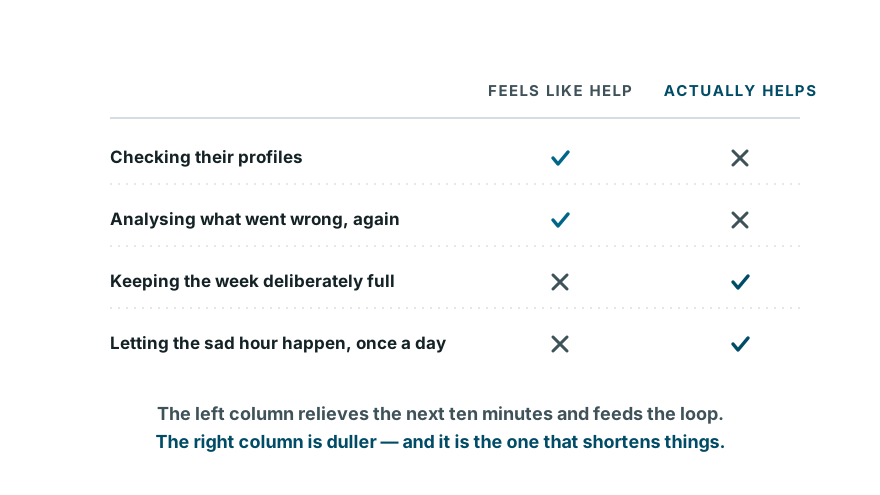
Checking on them — profiles, mutual friends, their new life — feels like information and works like contact: every check keeps the attachment active. The feed is not neutral; it is the relationship continuing at one remove.
The analysis sessions — replaying the ending, building the case, finding the moment it broke — feel like processing. In the first weeks they are unavoidable. As a nightly practice they turn into something else. Rumination is the replaying of an ending in the hope that one more pass will finally produce a verdict, and it is the loop wearing glasses.
A deliberately full week feels like avoidance and is actually structure: the evenings the relationship used to fill need new owners before they arrive empty, not after. For example, a Thursday that already holds a class, a shift swapped with a friend and a shopping list is a Thursday the loop has to compete for; an unplanned Thursday belongs to it by default. Plans made in advance beat willpower every time.
The scheduled sad hour sounds absurd and works: rather than fighting the grief all day and losing at midnight, give it a slot. Music, photos allowed, timer on. When it shows up outside the slot: noted, appointment’s at eight. It converts a flood into a tide.
The things nobody wants on the list
Sleep, food, movement, daylight, people. It is almost insulting to read them, and they are most of the treatment. Heartbreak is partly a physiological event — you are jittery, unslept and unfed on top of sad, and each of those multiplies the others. You cannot think your way out of a state you are chemically maintaining.
The repairs are dull, physical ones, such as eating at roughly fixed times, getting outside while it is light, and going to bed before the small hours. None addresses the loss. All of them change what you have to face it with.
The people item deserves one note: what helps is not advice but repetition rights — one or two people who will let you say the same things more than once without flinching. That is what processing actually looks like from outside.
How do I get over a breakup I still love?
You start while the love is still there, rather than waiting for it to leave first. Waiting stalls everything: the feeling gets treated as a gate, and the gate does not open on request.
Love is not the same thing as fit, and it is not a verdict on whether the relationship should have continued. Loving someone accurately and being unable to live with them are compatible; holding both at once is uncomfortable and correct.
The practical version is behavioural: you act as though it is over — channels closed, weeks with contents, no private negotiations at midnight — while still feeling that it is not. Imagine the version of them your head produces at that hour: warm, patient, saying the thing you needed. That version is edited, and it is the one being missed. Comparing it to daylight memory is not disloyalty; it is accuracy.
How long does it take to get over a breakup?
There is no honest number, and this page will not supply one. The figures that circulate — a fixed count of weeks, a fraction of the relationship’s length — are folklore or single unsourced surveys, endlessly reprinted. Where research worth citing exists, this site names it on the sources page; until then, no number.
What can be said without inventing anything: recovery is not linear, waves at triggers are normal deep into the process, and contact — including the digital kind — resets more than it checks. The measure of progress is not whether you think of them. It is what the thought costs when it comes.
When it does not lift
Grief over a real loss is heavy and normal, and the early weeks are supposed to be bad. But there is a border, and it matters: weeks passing without sleep or appetite, nothing lifting even briefly, no interest in anything returning, or thoughts that have turned dark. That is not a breakup running long — that is a health question, and a doctor or therapist is the right reader for it. Going is not an admission of anything; it is what the situation is for.
Where to start
If it is fresh: the first day has its own page, and it is deliberately small. If the contact loop is still running: no contact, explained without the magic. The rest of these notes build from there.