This is the most asked question about breakups, and nearly every page answering it gives a number. The numbers disagree with each other, which is the first clue.
How long it takes to get over a breakup is not a question with a researched answer — nothing this site can point to has measured recovery in a way that yields a duration you could apply to your own life. This page explains where the circulating figures come from, what actually sets the speed, and how to know you are moving without a calendar.
How long does it take to get over a breakup?
There is no honest number, and this page will not invent one. What can be described is the direction of travel: contact keeps the clock running, structure and sleep shorten what can be shortened, and the thought of them gets cheaper long before it gets rare. Anyone offering a figure is offering a convention, not a finding.
Where the famous numbers come from
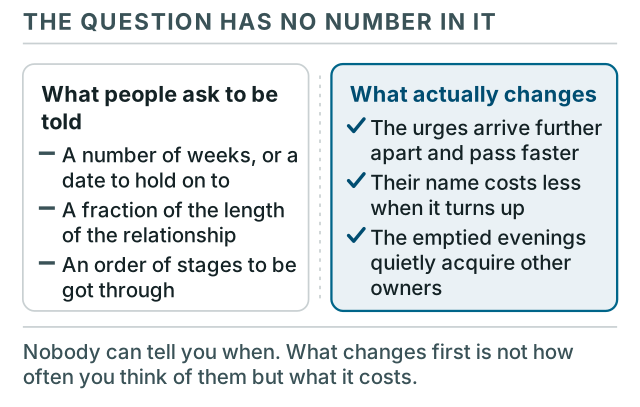
Every circulating figure belongs to one of three families. A fixed count of weeks or months, usually traceable to a casual survey — self-reports gathered by a magazine or a brand, never a measurement of recovery. A formula — some fraction of the relationship’s length — which has the appeal of sounding mathematical and the sourcing of a proverb. And stage models. Stage models are descriptions of the shapes grief can take, borrowed from a clinical setting and never presented there as a schedule; turning them into a timetable was somebody else’s idea.
Grief after a lost bond is not an unstudied subject. The attachment tradition — set out at length in Bowlby’s Attachment, the first volume of Attachment and Loss — takes the bond and what its disruption does as its subject matter. What that tradition describes is a mechanism. It does not hand out a duration, and the pages that quote a duration are not quoting it.
This site’s rule is that a number appears only with its source, its year, and the population it measured, on the sources page. None of the breakup-duration figures survive that test, so this page carries none. If one ever does — a real study, with a method — it will appear there with its caveats attached.
A number would be comforting. An invented one is a small lie sold as comfort, and the people selling it usually have a course underneath.
What actually sets the speed
No number, but the variables are describable, and they split into two piles.
Partly in your control:
- Contact. The single biggest lever. Every message, check and profile visit feeds the attachment loop and resets more than it satisfies. People who quietly monitor an ex for a year are not “slow healers” — they are one year into a relationship with a feed.
- Structure. Empty evenings are where the missing lives. A deliberately full week — arranged in advance, not summoned by willpower nightly — shortens things more than any insight does.
- The body. Unslept and unfed multiplies everything. Boring, decisive.
- Where the grief happens. Fought all day, it leaks into everything; given a scheduled slot, it compresses.
Not in your control:
- How it ended. A clean, explained ending and a vanishing act leave different wounds; ambiguity heals slower because part of the mind stays on the case.
- How interwoven your lives were. Years, homes, friend groups, routines — more threads take longer to unpick, and no formula converts thread-count into weeks.
- What else your life holds. The same loss lands differently in a full life and an emptied one — which is why the structure lever matters twice.
Consider two people who separated on the same afternoon. One clears the apps off the phone and arranges the week in advance; the other reads a profile every night before sleeping. They will not be on the same clock, and nothing about them had to differ except that.
Why is my breakup taking so long?
Because the loop is still being fed, often by something that does not look like contact at all. Checking feeds it. Asking a mutual friend feeds it. So does an ending nobody ever explained, which keeps part of the mind working the case; so does a week with too much unclaimed evening in it; so does treating every bad day as evidence that the whole thing has failed.
None of that is a defect in you. It is a list of inputs, and inputs can be changed — which is the only practical difference between a long recovery and a stalled one.
How do I know I am making progress?
Measure what the thought of them costs, not how often it arrives. The calendar is the wrong instrument; the useful one is what does the thought of them do to the next hour?
Early on, a thought of them takes the whole evening hostage. Working recovery looks like the same thought landing softer — noted, felt, and the hour continues. For example, a photograph that once ended an evening becomes something you look at, feel the weight of, and put down. The thoughts do not stop for a long time, and do not need to. They get cheaper.
Waves are part of this. A wave is a sudden return of grief set off by something ordinary, such as their street, a song, or news they would have loved. It can produce a bad day deep into an otherwise good stretch. A wave is weather, not a verdict; it says nothing about your total progress, and treating it as relapse is how people conclude they are “still not over it” years after they mostly are.
The comparison trap
The other clock people run is the other person’s: they seem fine, they are already seeing someone, therefore your grief is evidence of losing. Two things are wrong with that. You are comparing your inside to their outside — the visible part of anyone’s recovery is curated. And speed is not victory: an unmourned ending tends to get paid for later, with interest. Their timeline is not information about yours.
Where this page stops
Slow is normal, and waves are normal. What is different: weeks without sleep or appetite, nothing lifting even briefly, interest in things not returning at all, or thoughts that have turned dark. That is not a long breakup — that is a health question, and a doctor or therapist is the right reader for it. Going is not an admission of anything.
For the mechanics of shortening what can be shortened: how people actually get over it, and the tool at the centre of it.