
No contact is the most repeated piece of breakup advice on the internet, and most explanations of it are either a chore list or a sales pitch. This page is neither. It describes what the tool is for, how to run it, and — just as important — what it cannot do.
What is the no contact rule?
The no contact rule is a sustained stop to all voluntary contact with an ex, kept for your own recovery rather than for their reaction. Not a pause for effect, not a countdown they are supposed to notice. Messages, calls, reactions, story views, profile checks, asking mutual friends, orchestrated coincidences — all of it stops.
What remains is the involuntary minimum, such as children, shared property, or a workplace you both turn up to. Minimal contact is the honest name for that version: those interactions continue, but they become brief, factual and about the logistics only.
The distinction that matters: no contact is something you do for yourself, on your side of the line. The version aimed at the other person — going silent so they will notice the silence — is a different activity wearing the same name, and it keeps you exactly as attached as texting daily would.
Why does no contact work?
Because a habit that stops being used starts to fade, and contact is what keeps this one in use. A long relationship installs a reflex: something happens, you turn toward them. Good news, bad day, a joke they would like — the reflex fires dozens of times a day, and every time you act on it, you feed it.
A reply, a profile check, a “how are you” — each one is a small confirmation that the channel still exists, and the reflex learns that reaching works. Remove the channel and the reflex starts to starve. Not instantly, and not in a straight line — but reliably, the way any unused habit fades.
That is the whole mechanism. Nothing mystical: disuse. It is also not a new idea. The bond between two people and what happens when it is disrupted is the subject of Bowlby’s Attachment, the first volume of Attachment and Loss, and the tradition that grew out of it is surveyed in the open-access review An attachment perspective on psychopathology by Mikulincer and Shaver. Neither of those is a manual for breakups, and neither prescribes a rule. They are where the language of bonds and separation comes from; the rule is a practical use somebody made of it.
The urge to text them
The hardest part is not policy, it is the wave: the sudden, physical need to make contact, usually late, usually after something good or something bad.
Two facts about that wave are worth keeping somewhere visible.
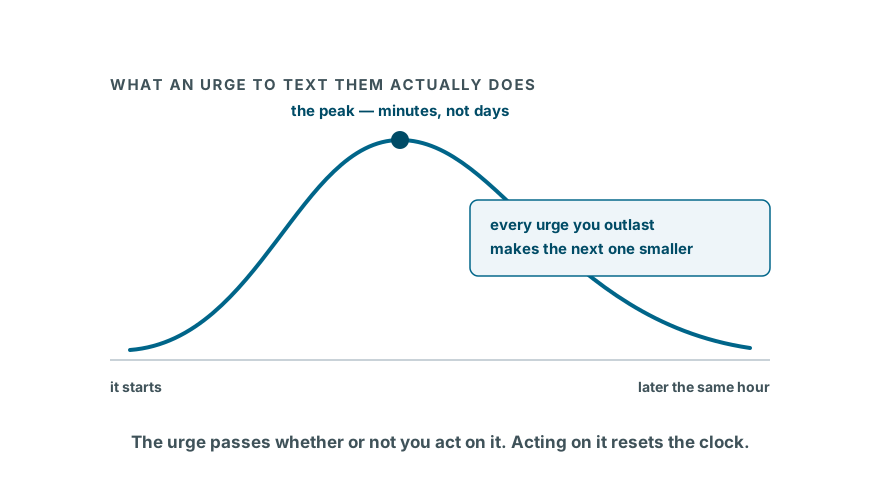
First: it peaks and passes on a scale of minutes, not days. It does not build forever; it crests. For instance, a shower, a walk to the end of the street, or ringing someone who will talk about anything else will often carry you past the crest — the point is only to still be busy when it breaks.
Second: each urge you outlast makes the next one weaker, and each one you act on makes the next one stronger. That asymmetry is the entire game. There is no neutral move.
How long does no contact last?
There is no researched number of days, and this site does not publish invented timelines. The fixed figures that circulate — pick any — are conventions, not findings.
The useful framing is not a countdown but a condition: no contact runs until contact stops costing you something. Until seeing their name does not reorganise your evening. People reach that point on wildly different schedules depending on the length of the relationship, how it ended, and how much structure the rest of their life supplies.
A countdown has one real use: making the first stretch survivable. If committing to “from now on” feels impossible, commit to a short fixed window and renew it. The renewal is the tool.
Do I have to block my ex?
Not necessarily — muting does most of the same work with less drama, because you stop seeing them without announcing anything. Block when muting is not holding: when you keep opening the profile anyway, or when they keep reaching in and each arrival costs you a day.
Neither choice says anything about you as a person. It is a dial you set to whatever keeps the channel shut, and you are allowed to turn it up later.
What counts as breaking no contact?
Anything done in order to feel connected to them, whether or not they ever learn about it. Breaking no contact means the voluntary act, not the sent message specifically — the loop lives in attention, so all of this counts:
- checking their profiles, or their friends’ profiles for traces of them;
- asking mutual friends how they are doing;
- drafting messages you do not send;
- keeping the chat open to reread;
- engineering reasons to be where they will be.
None of this makes you weak — it makes you a person with a strong installed habit. But each of these keeps the habit fed, and the honest name for a week of profile-checking is not “no contact with one slip”. It is contact.
Consider the version people describe as going well: no messages sent, the profile read every night before bed. Nothing was sent, and nothing faded either, because the reflex got exactly what it asked for.
If you break it properly — you texted, you met, you reopened it — the useful response is boring: note what triggered it, close the channel again, continue. The reset costs something. It does not cost everything, and the dramatic “back to day zero” framing mostly serves to make people give up.
What it cannot do
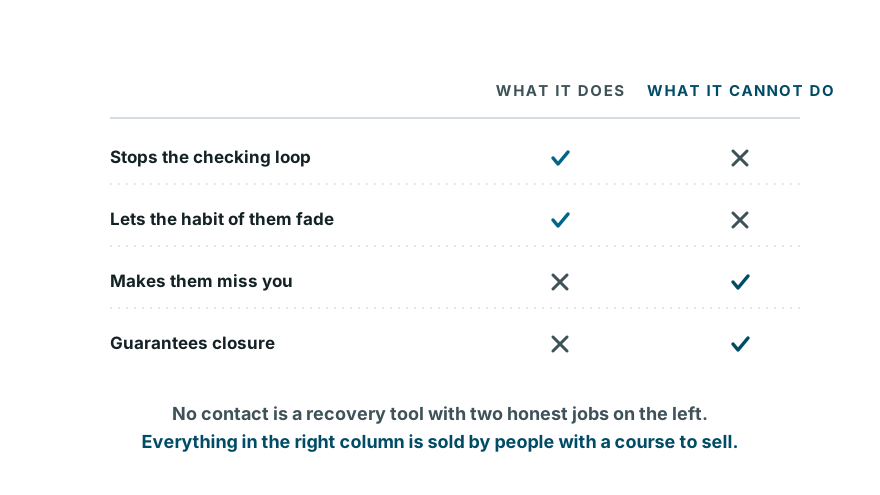
No contact will not make anyone miss you on demand, will not deliver closure by itself, and will not answer the question of what went wrong. It does one thing: it stops the bleeding so that ordinary recovery can happen.
That is also why it is not a punishment of the other person, and does not need announcing. A declared no contact — “I am going no contact with you” — is a message, and messages are contact. You just stop.
Where this page stops
If what is keeping the contact loop alive is not habit but fear — of what they might do, of what you might do, of being unsafe — that is not a breakup-advice question. And if weeks are passing without sleep or appetite, or the thoughts have turned dark, that is a health question: a doctor or a therapist is the right reader for it, and going is not an admission of anything.
For the rest: what to do in the first days while the rule takes hold, and what actually shortens the missing once it has.