
This search usually means one of two things. Either you want to know whether the silence is healing you — or whether it is affecting them. This page answers the first honestly, and is honest about why nobody can answer the second.
Signs the no contact rule is working are changes on your side of the silence: the pull to reach out arriving further apart, stretches of the day passing without them in them, their name costing less when it turns up. Every honest sign is a fact about you. None of them is a fact about your ex.
What are the signs no contact is working?
They are all changes in you, because you are the only side of the silence the tool can reach. No contact is a recovery tool rather than a signal you are sending, so its dial sits here:
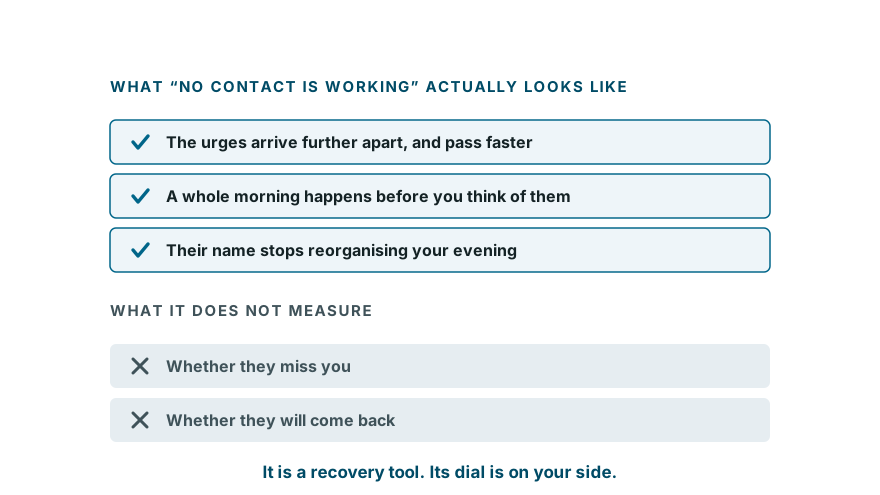
- The urges space out. Early on, the pull to text arrives hourly and each one is a fight. Working looks like: further apart, weaker, passing faster. Not gone — spaced.
- Unclaimed time appears. A whole morning happens and you realise, afterwards, that they were not in it. This tends to be the first sign people actually notice, and it usually arrives before they feel “better”.
- Their name gets cheaper. Seeing it — in a chat, a memory, a mutual friend’s story — stops reorganising the rest of the day. The thought still comes; it costs less.
- The evenings refill. The hours that used to hold the relationship stop being holes you brace for, because other things have started living there.
None of these arrive on schedule, and none arrive in a straight line. Consider a brutal Sunday in the middle of an otherwise decent week: nothing has been reset, and nothing has to be started again. Waves at triggers — a song, a street, an anniversary — are part of the pattern deep into recovery, not evidence of failure.
How do I know if my ex misses me during no contact?
You cannot, and neither can the pages that promise to tell you. Monitoring is the practice of reading someone’s public activity for evidence about their private life: story views decoded, posting patterns read like tea leaves, mutual friends treated as an intelligence network.
For example, a story view at two in the morning can be longing, boredom, a thumb slip, or an algorithm putting your name at the front of a queue. There is no method that separates those, so the reading is always the one you were already hoping for.
Plainly: silence produces no data about the other person. The confident checklists exist because “signs your ex misses you” is one of the most searched phrases in this niche, and pages that promise decoding get the clicks — most of them from sites whose actual product is a get-them-back course.
And the deeper problem: monitoring for signs is contact. Attention is the channel. A week spent decoding their profile is a week the attachment got fed daily while you technically sent nothing — and the pull it is feeding is the ordinary business of a bond, the thing Hazan and Shaver’s paper on romantic love as an attachment process put on the map for adult relationships. If the honest goal is still their return, the tool you are using is not built for that goal — here is what it is built for.
How long until no contact starts working?
There is no honest answer in days. The fixed spans people quote at each other are conventions somebody invented and everybody repeated, not findings, and a page that gives you a date is guessing with a straight face.
What can be said is the shape. The early stretch is the loudest part, and the signal to watch is direction rather than duration: urges weakening, the gaps between them lengthening, the recovery of ordinary time. Direction is visible over weeks, not over an afternoon of checking how you feel.
What if it is not working and I feel worse?
Feeling worse at the start is not evidence the tool has failed. Contact was anaesthetic — every check and reply took the edge off — and removing anaesthetic exposes the wound. That ache is the condition the tool exists to let heal, not a verdict on it.
What helps while it is loud: the urge management from the texting page, a deliberately full calendar, and treating sleep and food as part of the treatment rather than casualties of it.
There is a border, though, and it matters: weeks without sleep or appetite, nothing lifting even briefly, or thoughts turning dark — that is not a discipline problem or a stage to push through. That is a health question, and a doctor or therapist is the right reader for it. Going is not an admission of anything.
If they break the silence
A message from them lands differently during no contact — it feels like the sign you were waiting for. Before treating it as one, read what it actually is: often it is their two-in-the-morning urge, set off by something ordinary such as a photograph or a bad evening, and it means about as much as yours would.
You owe no reply. If you choose to respond, decide what the reply is for before opening the thread, and let it end where you decided.
The honest summary
No contact is working if you are recovering. That is the entire metric. The version that measures their longing is astrology with a checklist — and it is sold, profitably, to people at their most hopeful.
The rest of recovery — what actually shortens the missing — is its own page.