
Most no contact advice assumes you can vanish from each other’s worlds. Plenty of people cannot: the ex is two desks away, in the same seminar, at the family table of a shared friend group. This page is for that version — because the rule still works there, once you know which part of it was ever doing the work.
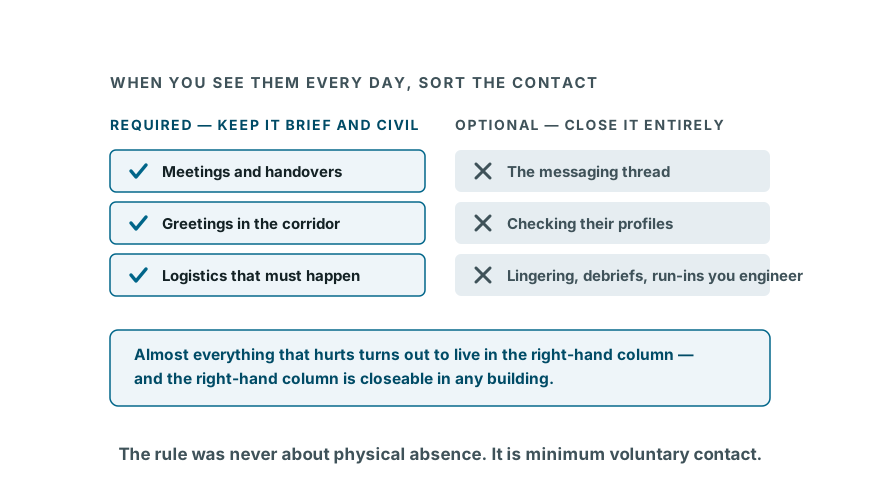
No contact when you work together is not silence, which is unavailable to you, but minimum voluntary contact: the required interactions happen, briefly and civilly, and the optional ones go to zero. Almost everything that hurts turns out to have been in the optional column.
Does no contact work if you see each other every day?
Yes, in the only job it has — letting you recover — because full silence was never the mechanism. It was the easiest way to get the mechanism. Voluntary contact is everything you choose to initiate: the messages, the checking, the engineered walk past their desk, the debriefs with mutual friends. That is the column that keeps the wound open. Passing them in a corridor reopens very little. Rereading the thread at midnight reopens everything.
It helps that the bond is to a person rather than to a place. The tradition that studies adult relationships this way — the line of work Hazan and Shaver’s paper on romantic love as an attachment process opened — is about a tie to one particular someone, not about how often the two of you are in the same room. A shared building does not maintain the tie. Attention does, and attention is yours to withdraw.
What do I say when I have to talk to my ex at work?
The same things you would say to a colleague you neither love nor hate: greetings, logistics, the work. The exhausting part of seeing an ex daily is not the seeing — it is deciding, every time, how to be. Decide once, in advance:
- The greeting. Pick one — a nod, a “morning” — and use it every time, in every mood. Consistency reads as composure and costs nothing.
- The required conversation. About the work, brief, complete. You are aiming for unremarkable: an observer should not be able to tell there is a history.
- The exit. Have a standard line ready, such as “right, I need to get this back to them” — so conversations do not drift into the personal by inertia.
Warmth is not required. Hostility is not affordable — it reads badly to everyone watching and keeps you engaged with them emotionally, which is the thing you are trying to stop.
Should I quit my job or change my routine to avoid my ex?
Change the cheap things immediately and leave the expensive ones alone for now. A different gym slot, a different coffee run, a seat across the room, muting them everywhere online even though you will see them in person — take all of these without guilt. They are logistics, not defeat.
Expensive changes — leaving the job, dropping the course, exiting a friend group — deserve slower thinking. Sometimes they are right; a workplace can genuinely be unlivable with the wrong history in it. But decide after the acute weeks, not during them, and for your life rather than for anaesthesia. Consider the resignation drafted on a bad Tuesday afternoon: it is answering the afternoon, not the career, and it will still be available later if it was ever a real idea. The first-week rule about big decisions applies with full force here.
The shared friend group
You can keep the group and still run the rule with the person. Attend the things. Be civil in the room. Do not seek them out; do not perform recovery at them; leave when leaving is natural.
Two sentences to friends do most of the protecting: I’d rather not hear news about them for a while — and — please don’t relay anything about me either. What breaks people in shared groups is rarely the shared room; it is the informant network and the post-event debrief, and both are optional.
If the group cannot hold both of you without drama, that is information about the group, and it is fine to attend less for a season. A season — not an exile.
Do accidental run-ins reset no contact?
No — an encounter you did not choose changes nothing about your recovery. A run-in is the unscheduled minute a corridor, a kitchen or a lift hands you. It rattles; that is normal; waves work like waves.
There is no streak to reset. A version of no contact that can be ruined by a lift is a game, not a tool, and the counter is a trap because it moves your attention from what you are doing to what is being done to you. The only thing worth watching is what you initiate. The run-in is weather. The message you draft an hour later, the checking spiral it tempts you into — those are choices, and the same one-question test applies.
Where this page stops
Daily forced proximity to an ex is hard, and ordinary. Two borders, though. If their behaviour toward you at work crosses into hostility, pressure or anything that affects your standing — that is a workplace matter for a manager or HR, not a recovery exercise. And if there was fear or control in the relationship, proximity is a safety question first: the right support is a professional or a safety resource, and adjusting your environment to stay away from them is not an overreaction.
Otherwise: close the optional channels, script the required ones, and let time do what it does. How the rest of the tool works is here.