
Somewhere between the second week and the second month, almost everyone stands in the kitchen holding a phone with a message drafted. This page is for that exact moment, and it is built around one question.
Should I text my ex is really a question about purpose rather than wording. Nobody stalls over a message about returning a coat; the drafts that get held for an hour are the ones with a hope attached, and the hope is what has to be answered first.
The only question that sorts it
What do you want to happen after they read it?
Not what the message says — what it is for. Answer honestly and almost every case sorts itself:
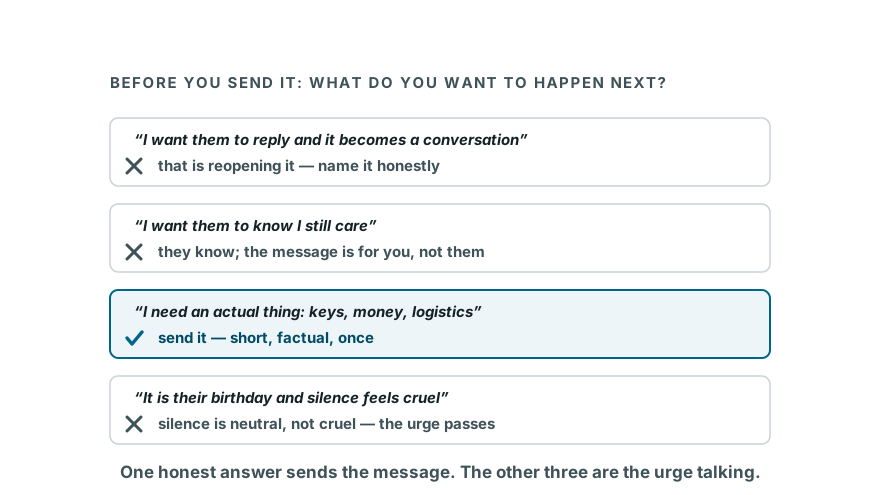
“I need an actual thing” — keys, documents, money, the cat’s vet records. Logistics are the messages you would still have to send if you felt nothing at all, and they are the one channel that stays open. Send it: short, factual, one topic, no postscript about how you have been. Keeping them boring is what keeps them safe.
“I want a reply” — then the message is a fishing line, whatever its text says. What you are actually asking for is contact, and contact is the thing that keeps the wound open. The honest name for this message is reopening it.
“I want them to know I still care” — they know. People remember who loved them. The message would not deliver information; it would deliver you, back into their evening and them back into yours.
“Silence feels cruel” — it is not. Silence after an ending is the neutral state, not an attack. The feeling that you owe them contact is the habit negotiating for its old job.
The test survives disguises, which is the point of it. For example, a message that only asks whether they still have your charger, sent to someone who moved out months ago, is a logistics message on the surface and a fishing line underneath — and you already know which one it is, because you know what you will do with the reply.
Should I text my ex happy birthday?
You are not obliged to, and a birthday that passes in silence is neutral rather than cruel. The birthday message deserves its own section because it is the single most common way no contact ends. It feels small, socially required, and deniable — it would be rude not to.
Three things about it, plainly. It is not required: adults survive birthdays without messages from their exes, and yours did too. It is not small: it is contact, and both of you will read it as contact. And it is not deniable: the reply — or the absence of one — will occupy your day, which is the opposite of what this stretch of time is for.
If you genuinely, calmly want to be someone who exchanges birthday wishes with this person — that is a real thing former partners sometimes have. It lives years away, next to actual friendship with an ex, not in month two.
Why do I want to text my ex so badly at night?
Because the pull is loudest when you are tired, unoccupied and holding something you used to hand straight to them. The urge is a habit firing into a gap: it peaks at night, after good news, after bad news, and after seeing anything that belongs to your shared past.
It feels like it will build until you obey it. It will not: it crests and passes within the hour, whether or not you act. Reaching for one specific person when you are hurt is also not a personal defect — it is the behaviour the attachment tradition set out to describe, and Bowlby’s Attachment, the first volume of Attachment and Loss, is the book that framed it that way. Knowing that does not make it quieter. It does make it less shameful to wait out.
What helps in the moment, in rough order of effectiveness:
- Change rooms. The urge lives where the phone and the quiet are.
- Draft it somewhere it cannot be sent. Notes app, paper. Everything you needed to say gets said; nothing gets delivered. Most drafts read very differently in the morning, which is the information you needed.
- The one-hour rule. Not “never” — just not for an hour. The urge cannot hold its breath that long.
- Tell one person. “I want to text them tonight” said out loud to a friend has defused more relapses than any technique.
My ex texted me. Should I reply?
You owe nothing: no reply is a complete, legitimate answer, and it is not cruelty — it is the boundary doing its job.
If you choose to reply, decide before opening the thread what the reply is for: logistics, or a short factual close. One message, no questions in it, done. What undoes people is not the reply. Consider the third message: a closed thing has quietly become a conversation again, nobody has said so out loud, and the weeks you spent running the clock have reset while you were being polite.
The same applies to whatever arrives dressed as an accident — a photo sent to the wrong person, a question they could have asked anyone. It is their urge in the same shape as yours, and it carries no more information than yours would.
Is there a message that will make my ex want me back?
No, and the people selling one are selling hope by the word. Word order does not change decisions; the templates and the “texts that reignite attraction” exist because people at their most hopeful are people at their most buyable. That entire industry is why the no contact page on this site describes a recovery tool and not a strategy.
The want behind the draft is real and normal. The message is just not the tool for it. The tool is time without contact, which is exactly what the draft is asking you to give up.
Where this page stops
If what keeps you reaching for the phone is fear — of them, of what they might do, of what happens if you do not answer — that is not a texting question, and this page is the wrong tool. And if the nights are getting darker rather than just lonelier, a doctor or a crisis line is the right reader, tonight. Going is not an admission of anything.
Otherwise: put it in the notes app, leave the room, and check what actually shortens all of this.