
There is a specific quality to the moment: the photo, the mutual friend’s careful mention, the two of them in a supermarket aisle. People who handled the breakup itself with some grace describe this as the thing that flattened them.
My ex moved on means one verifiable thing — they are living their life, with someone else in it. Everything else people extract from it, about what the relationship was worth or who mattered more, is added by the person reading the photograph.
Why does my ex moving on hurt so much?
Because it ends the ambiguity, and ambiguity was holding more weight than anyone admits. The breakup ended the relationship; this ends the maybe. While nothing was visible, some quiet part of the head kept the file open: maybe, eventually, once things settle. The new person closes the file in public.
So it lands like a second breakup, and in one way a harder one: the first had a conversation, this one has an audience. Nothing has actually changed about your situation — they were already gone — but a possibility you may not have known you were still holding is now visibly gone, and grief for a possibility is still grief.
Knowing this does not blunt the wave, but it names it correctly: you are not mourning them again from scratch. You are mourning the maybe. That is a smaller thing than it feels like tonight.
Did our relationship mean anything if my ex moved on so fast?
Their speed measures their next relationship, not your last one. Here is the honest catalogue of what “they moved on fast” can mean, from the outside where you are standing:
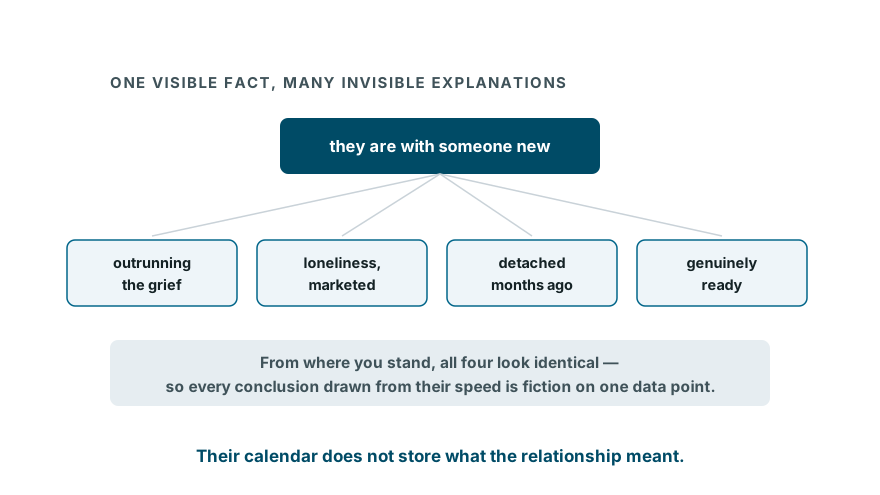
Fast can be avoidance — a person outrunning grief by not sitting in it. Fast can be loneliness with better marketing. Fast can mean they were detaching for months while the relationship formally continued, so their clock started long before yours. And occasionally fast is just fast, and it holds.
You cannot tell which from outside. Neither can the mutual friends confidently narrating it. Which means every conclusion drawn from their speed — it meant nothing to them, I was replaceable, they never loved me — is fiction built on one data point. Consider the same evidence read the other way: a person who cannot be alone for a week is not demonstrating that the relationship was light, and the calm, slow one is not demonstrating devotion. Both readings fit the photograph, which is exactly why the photograph decides nothing.
The relationship’s meaning is not stored in their calendar, and who grieves longer is not a measure of who loved more; it is mostly a measure of who processes how. The attachment tradition — the subject of Bowlby’s Attachment, which is about the forming and breaking of such bonds — is a description of a process, not a stopwatch that ranks the participants.
Is my ex’s new relationship a rebound?
You cannot know from outside, and the classification is not the useful part anyway. Rebound-watching is the practice of following an ex’s new relationship as though its failure would settle something about yours — the tempting consolation, it’s a rebound, it won’t last.
Notice the position it puts you in: following their story with a scorecard, waiting for a result. If it fails, you have wagered your recovery on their relationship’s schedule. If it holds, the second collapse is worse than the first.
Their next relationship is not your project in either direction. The only timeline that pays anything is your own.
How do I stop checking my ex’s new relationship?
Close the channel rather than arguing with the curiosity — the curiosity fades once it stops being fed. The checking works exactly like every other checking loop: each look buys a minute of knowing and hours of processing, and the surfaces have multiplied — such as their stories, the new person’s profile, and the mutual friend whose photographs now contain both of them.
The moves are unglamorous and effective: mute or unfollow both of them — the new person’s profile is the same wound at a different address; tell the informants, plainly, I’d rather not hear updates; and when the urge to look arrives, treat it as an urge — it peaks, it passes, each outlasted one shrinks the next. For example, the friend who opens with “have you seen…” can be stopped in the same sentence with “I’d rather not know” — awkward for a moment, and it removes an entire supply line. If you slip and look: noted, weather, continue. There is no streak to reset.
If you run into them in person, the job is smaller than the rehearsal suggests: be ordinary, be brief, leave naturally. It is not a referendum on your recovery, and the wave afterwards is expected and finite.
Does my ex moving on mean I should too?
You were already allowed to, and their timing does not grant or withhold permission. The comparison instinct is the reflex that reads their life as a scoreboard — they’re ahead, I’m behind — and it accepts a premise worth refusing: that the two recoveries are one race. They are not. Being sad longer than them is not losing; getting someone new first is not winning; the whole scoreboard is a way of keeping your attention on their life.
Recovery has its own uneven clock, and yours is the only one running on your side of it. What that clock responds to is the same as ever: inputs closed, weeks with contents, the missing allowed to fade.
Where this page stops
The wave that follows this discovery is normal, and it passes. The border: if it tips into weeks of hopelessness, broken sleep, self-worth in the floor — a mood that will not lift rather than a wave that keeps passing — that is a health question, and a therapist or doctor is the right reader. Going is not an admission of anything.
Otherwise: close both channels, refuse the scoreboard, and give the weeks contents. The rest of the mechanism is here.