“Just stop thinking about them” is advice nobody has ever successfully taken.
How to stop thinking about my ex is a question about attention rather than willpower, whatever it feels like from inside: the thoughts thin out when the loop that produces them stops being fed, and they get louder when you attack them directly. This page explains why the direct order fails, and what actually works instead.
Why can’t I stop thinking about my ex?
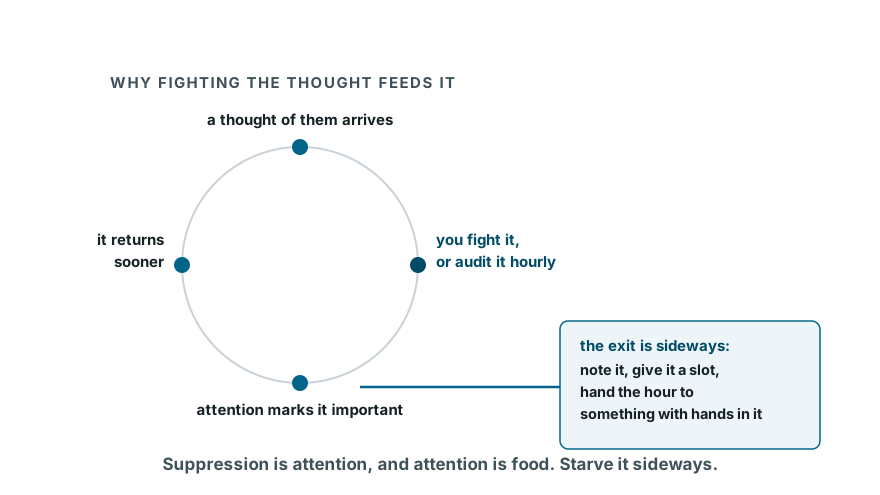
Because the effort of not thinking about someone is itself a way of thinking about them. Try not to think of a white bear, and the mind must hold “white bear” in view to check it is not thinking about it. Thought suppression is the attempt to push a thought out of mind by force, and it carries its own target inside it — the monitoring is the thinking.
Breakup thoughts get this twice over. The relationship installed that person as the most-worn path in your attention: for years, everything notable routed toward them. That an adult partner ends up occupying this kind of position is the subject of a long research tradition — Hazan and Shaver’s Romantic love conceptualized as an attachment process is the paper usually named as its starting point for adult relationships. Now the path fires on its own — and on top of it runs the auditor, checking hourly whether you are over it yet. Both layers are attention. Attention is food.
So the goal is not a clean head by force. It is a loop that thins because it stops being fed.
Cut the refresh sources
A thought that gets fresh material daily never fades. The feeds are obvious once listed:
- their profiles — every check is a new image with a timestamp, hours of processing in a thumbnail. Checking is contact;
- the archive — chats, photos, voice notes. Not deleted, necessarily; out of reach: buried in a folder, backed up off the phone;
- the informants — mutual friends volunteering updates. One sentence fixes it: I’d rather not hear news about them for a while;
- the auditing — asking yourself, hourly, whether you are over it. The measurement is a feeding.
None of this erases the person from memory. It stops the memory being resupplied, which is the part you control.
Give the grief a slot
The counterintuitive move that works: instead of fighting the thoughts all day and losing at midnight, schedule them. A daily slot — with an end time — where missing them is the entire agenda. Music allowed, photos if you must, timer on.
When the thoughts arrive outside the slot, the move is not suppression: it is noted — appointment’s at eight. That is not a trick of denial; the thought was received, and it has a place. What changes is that it stops owning every hour that contains it.
The same mechanics as the sad hour on the recovery page — this is that tool pointed at rumination specifically.
Replace, don’t erase
An empty hour returns to its most-worn path — which is why the thoughts win nights, commutes and Sundays. The competition has to be real: engaging enough to hold attention, scheduled so it happens without willpower.
What tends to actually compete: things with hands or bodies in them, such as cooking, a gym session, or a walk with someone who talks; things with other people’s voices in them; and things with progress you can see. What does not compete: scrolling, prestige television at half-attention, and any activity chosen to look like thriving. The feed in particular is a trap here — it holds the eyes and leaves the loop the rest of the head.
The analysis session deserves its own mention. Rumination is the repeated replaying of the same material without arriving anywhere new, and it is very good at passing for work. Consider the nightly replay of the ending: it feels like processing and functions as rehearsal, and each run wears the path deeper. The test between them is whether anything comes out. Processing produces something — a realisation, a decision, an ending. Rehearsal produces the same conclusions in the same order and a worse night. If the tape has played identically for a fortnight, it is not working; it is looping.
Why do thoughts of my ex get worse at night?
Because the day’s competition shuts off — no tasks, no colleagues, no noise — and an unoccupied mind returns to its most-worn path. Most of this problem lives in the gap between the last task and sleep.
What blunts it is unromantic: a wind-down routine boring enough to be automatic, the phone charging outside the bedroom, and something low-effort for the ears. For instance, a dull podcast at low volume outperforms silence, because silence hands the room to the loop.
Bad nights still happen, and they are weather, not verdicts. A single two-a.m. spiral deep in an otherwise decent stretch means the loop fired, not that you are back where you started.
Does thinking about my ex mean I should go back?
No — frequency of thought measures how deep the habit runs, not how good the relationship was. The most-worn path in your attention is worn by repetition, and repetition happened whether the relationship was working or not. You think constantly about songs you dislike for the same reason.
If there is a real decision to make about that person, it deserves evidence: what the relationship was actually like on ordinary weeks, what changed, what you were each prepared to do about it. What your attention does at midnight is not on that list.
What changes first as the thoughts fade?
The cost drops before the frequency does. First the thoughts land and the hour continues anyway. Then the gaps widen — a morning happens without them in it, noticed only afterwards. Only much later does frequency itself fall.
People who expect silence first conclude they are failing while the process is working exactly to spec. Knowing the order is most of the protection against that.
Where this page stops
Looping thoughts after a loss are ordinary. The border: thoughts that stay intrusive for weeks, crowd out sleep and work, or arrive welded to hopelessness or self-blame that will not shift. That pattern has a name and treatments, and a therapist or doctor is the right reader for it — going is not an admission of anything.
Otherwise: starve the loop, schedule the grief, fill the week. The rest of recovery is here.