
This is one of the most searched phrases about breakups, and nearly every page answering it sells something: a method, a set of texts, a countdown with phases. This page is the other answer — the one nobody profits from.
How to get your ex back is the one question on this site with no technique attached to its answer, because there is no technique: reunions happen, and nothing you do out here causes them. That sounds like a refusal. It is the only version of this page that is not a sale.
Is it possible to get my ex back?
Reunions do happen — and no method produces them.
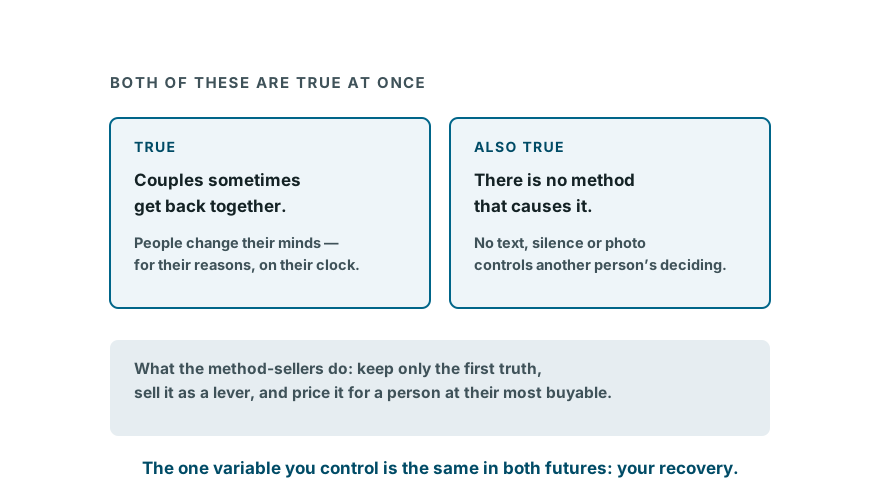
Couples sometimes get back together. People change their minds; endings get revisited; some reunions even hold. All of that is true.
And there is no method. The change of mind happens inside the other person, for their own reasons, on their own clock. It is not produced by the right message, the right silence, the right photo at the right party. Anyone selling you the mechanism is selling weather control.
Holding both of those at once is the whole page. What follows is why the second half is so hard to believe — and what to do instead of a campaign.
Why does every other page promise a method?
Because hope is the most monetisable feeling in this niche, and a person who wants someone back will pay for anything that looks like a lever.
Search this phrase and you meet an industry: coaches, courses, “proven systems”, texts that “reignite attraction”. Look at the shape of the product, though. For example, a script of messages sold as a sequence cannot fail as a product: if the ex returns, the script worked; if not, you sent them wrong, or too early, or in the wrong tone — a shape shared with every horoscope. And the timelines with phases exist to keep you engaged with the product, not with your life.
None of this means the people selling it are always cynical. It means the market rewards telling you that you have control where you do not.
What are the signs my ex will come back?
There are none that can be relied on, and this page is not going to invent any.
The signs-they-will-come-back genre is tea-leaf reading with a search-friendly title: it takes ordinary digital noise, such as a story view, an old photo liked, or a remark passed on by a mutual friend, and presents it as data about another person’s intentions. Those signals are equally compatible with wanting you back, with idle curiosity, and with nothing at all. Reading them is the checking loop wearing the costume of research.
What you actually control
One thing, and it is not small: what you are like, and what your life is like, from here.
That is not a consolation prize dressed up. It is the only variable that matters in both futures. If they never come back, your recovery is your life. If they do — reunions that hold happen between two recovered people who chose again, not between one person who waited and one who wandered back to a shrine.
No contact is the first part of that, and it is worth being exact about it: a recovery tool that stops the checking loop and lets the habit of reaching for someone fade. Run as bait, it keeps you attached while pretending to detach.
So the honest programme looks identical to the recovery programme, because it is the same thing: contact off, the weeks structured, the missing allowed to fade. Run it for yourself, not as a performance for an audience of one — the difference is real, and the other person can usually feel it.
Should I tell my ex I want them back?
Only in one situation, and it is not the fresh-breakup one: when real time has passed, you are substantially recovered, something material has changed, and you are prepared for either answer.
There is a legitimate version of reaching out, and it is nothing like a campaign. It looks like this: real time has passed; you are substantially recovered; something material has changed — circumstances, understanding, the thing that broke it; and you are genuinely prepared for either answer.
Then: one honest conversation. Not a speech, not a letter with an arc — a plain statement of where you stand and a question about where they do. Once. What makes it legitimate is that it is information, not pressure, and the answer ends it either way. Consider the difference between telling someone where you stand and asking them to reconsider on the spot: the first can be received and set down, the second is a weight handed to a person who already put it down.
What that is not: the fresh-breakup declaration, the drunk call, the anniversary message. Those are the urge talking, and they reopen more than they ask.
When is getting back together a bad idea?
When the reasons it ended are unchanged, when reconciliation is being asked to stop the pain of the breakup, and always where there was fear, control, or a repeating break-up-and-return cycle.
Worth saying plainly, because the wanting does not check these boxes on its own:
- The reasons it ended are unchanged. A reunion re-runs the same relationship with more scar tissue. Relationship research has looked at that ground — Gottman and Levenson’s Marital processes predictive of later dissolution studies how two people interact over time, not what one of them can do from outside to reverse an ending.
- The pain is doing the deciding. Wanting them back to stop the hurting is anaesthesia, not choice — and it fades exactly when the pain does.
- The pattern is circular. Break up, reunite, repeat: each loop buys short relief at the cost of both people’s ability to leave or stay cleanly.
- There was fear or control. Then this is not a reunion question at all, and the right support is a professional or a safety resource — not a page, and not the relationship.
What to do with the wanting
It is normal, it is not a plan, and it does not need to be obeyed or exorcised. Treated as weather — allowed, scheduled, outlasted — it fades on the same clock as the rest of the missing. Treated as a project, it grows.
The one move that serves you in every version of the future is the same: build the recovery. Everything else on this site is the how.